Looks like you’re on a phone.
This site works best on a desktop, please switch devices to continue.
RIDERS
WHO FEAR
NO DISTANCE
by Ali Mostafa
“Oh, rider of the beast who fears no distance,
Untamed by this man, or that, or that.
Its skin is fine, and its heart even finer,
Stubborn by nature, unfazed by madness or wrath.”
With these verses, the Sinai Bedouin poet Oneiz Abu Salem described the relationship between a rider and his camel. He portrays a rider whose mount fears no distance and is ridden by no one but its owner; a camel with delicate skin, an even more delicate heart, a stubborn nature, and a speed that outpaces even the spirits.


This Project portraits the traditional camel races of the Sinai Peninsula, and their young protagonists. For generations these races have been a central part of lives and livelihoods and a source of pride for many living here. People travel long distances across the peninsula's harsh desert terrain to participate in and spectate the races. Through a fortunate coincidence I got a rare chance to capture all of it, and get close to the communities around the races. My access came through a central figure of the sport, the trainer Ramadan Al-Balawi. He refused to play a central role in this story, and I only got permission to photograph him once. Nonetheless, I have followed him and his brothers and cousins across the peninsula between the racetracks presented in this project, where I met all the people you’ll meet too.

First saw Ramadan Al-Balawi in April 2023, at the camel races on the Al-Arish track in North Sinai. He was standing straight up on the back of a moving camel, concentrated and fearless. At the time, Ramadan was eighteen years old, working as a specialized camel trainer on racetracks in Sinai and beyond, he coached the camels and the young jockeys, helping them master the art of racing.

On a racetrack stretching nearly eight kilometers west of Al-Arish, Ramadan stood beside his cousin, Majd, at the starting line, giving him last-minute instructions. Majd set off with more than fifteen other participants. Ramadan and I tried to keep up in his car, but suddenly, the camel changed its course and rebelled. Ramadan screamed from the car window, "Majd, don't hit him! Don't hit him!" referring to the camel.

With his small frame, Ramadan leaped from the car and ran to catch the camel. At first, I thought it was a battle already lost, a fight against an animal that surpassed him many times in size and speed, but I soon realized I was mistaken. After several attempts, Ramadan managed to control the camel, and they lost the race, but as he said, it was just a race. "next time we'll win," he said. And that is exactly what happened three months later, at the Al-Sir track in the city of Al-Hasana.
At the Al-Arish race, the oldest and largest in Sinai, trophies await their champions. On opening day, more than ten heats are held for different categories of camels and riders. The first-place winner of each heat receives a trophy a symbol of victory and a testament to earned pride.
"Mabrook Al-Namoos!"
This is how the camel people congratulate a winner. It is an honor sought by all participants, from the track of Al-Arish to Alamein, Al-Sir, Sharm El-Sheikh, Ismailia, Al-Tor, and Al-Zalqa. Ramadan and his brothers spend their time with their camels, moving from one racetrack to another in search of the prestige of victory. The rest of the year, they dedicate themselves to training the camels and teaching the young children how to ride them.That’s how camel racers congratulate the winners a greeting every participant seeks. From Midan Al-Arish to Alamein, Al-Sirr, Sharm, Ismailia, Al-Tur, Al-Zalqa, and beyond, Ramadan and his brothers spend their time traveling from one racetrack to another, chasing victory. The rest of the year, they train their camels and teach young riders how to mount and race them.

Camel racing is the most popular sport among the Bedouins, and in Sinai, the Al-Arish track was the most famous. It is located in the village of Al-Midan, west of the city, but it was closed between 2011 and 2022 due to the war.

Ramadan says, "In those years, we camel owners were greatly affected. I was young when many trainers left Sinai for different places because of the events. We stopped participating in the Arish race and started looking for other races."

The Al-Arish race was the most important and renowned in Sinai, being an international event, but it is no longer what it once was. "I had to learn more about training camels after the trainers left North Sinai," Ramadan continues. "I learned a lot from my family until I became their own dedicated trainer."

Ramadan lives with his family in Ghuraif Al-Ghazlan, a small residential gathering for the Bili tribe in the desert between Al-Arish, Bir al-Abd, and Al-Hasana. Like all camel people, they live in the desert, as it suits the environment for herding and training camels, but they are forced to confront its harshness.

It is not only the harshness of the desert that Ramadan and his brothers face, but also the technological development that has gradually crept into the world of camel racing, replacing the trainer with a robotic jockey, a small device attached to a mechanical stick to beat the camel during the race instead of the camel jockey.

Bedouins divide the races between camel riders and automatic jockeys to preserve the jockey profession. However, they encounter other rules in official races that prohibit jockeys under the age of 16 from participating, despite some becoming professional camel jockeys at as young as five.
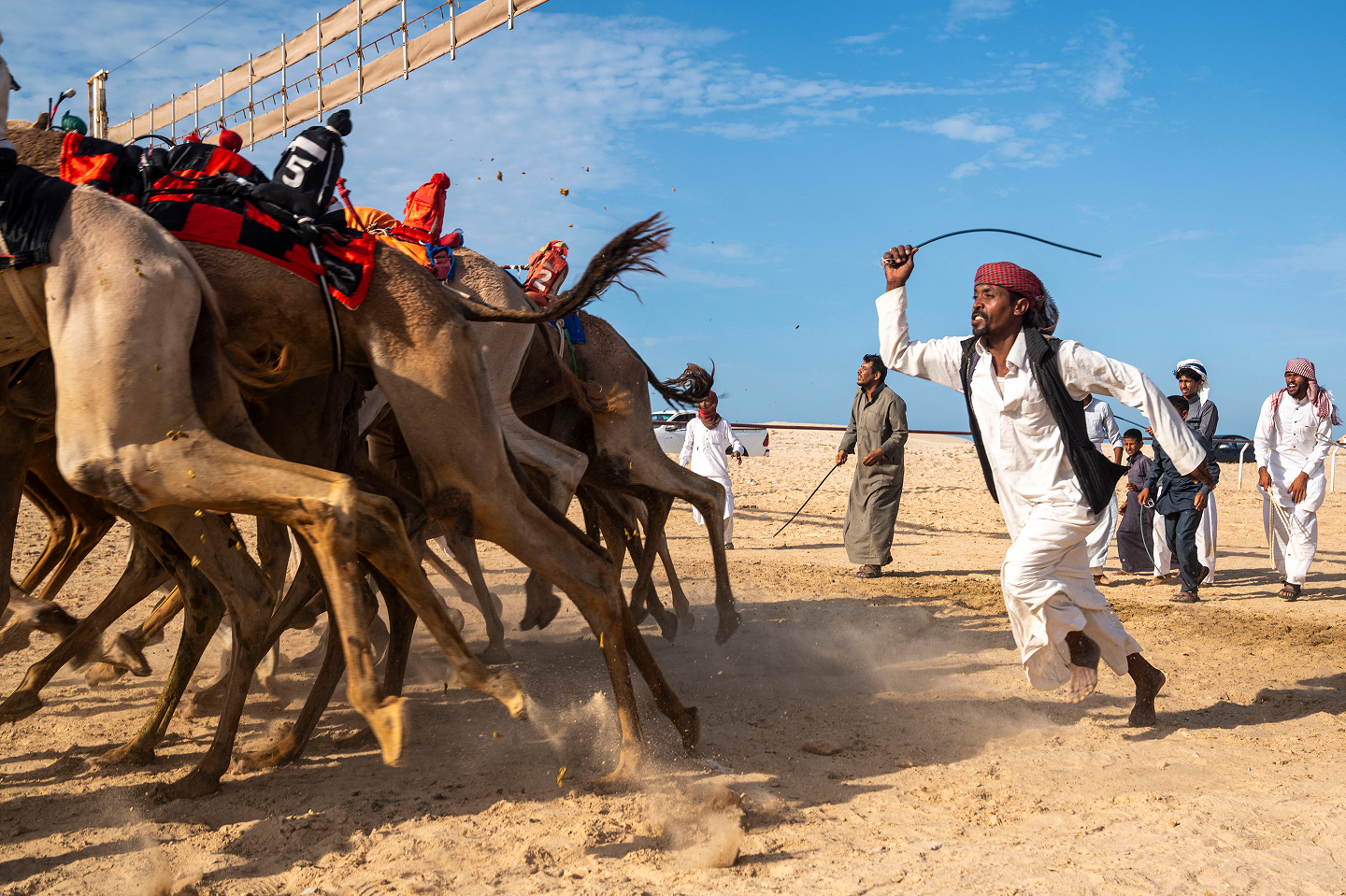
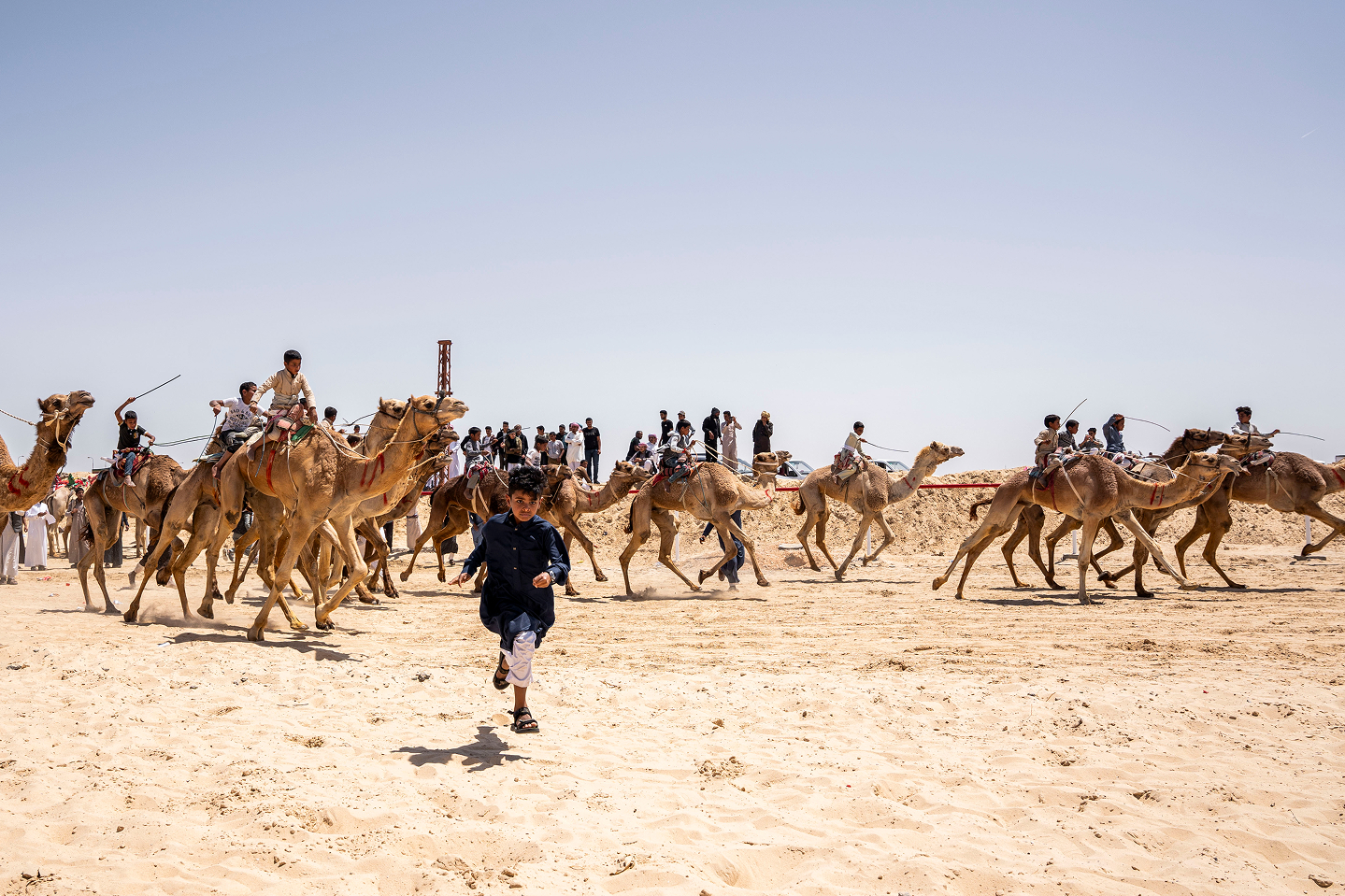
A handler urges the camels forward as the starting gate lifts at the Al-Arish racetrack. Some camels get spooked when the barrier rises, so the handler's shouts prevent them from hesitating or falling back from the race.
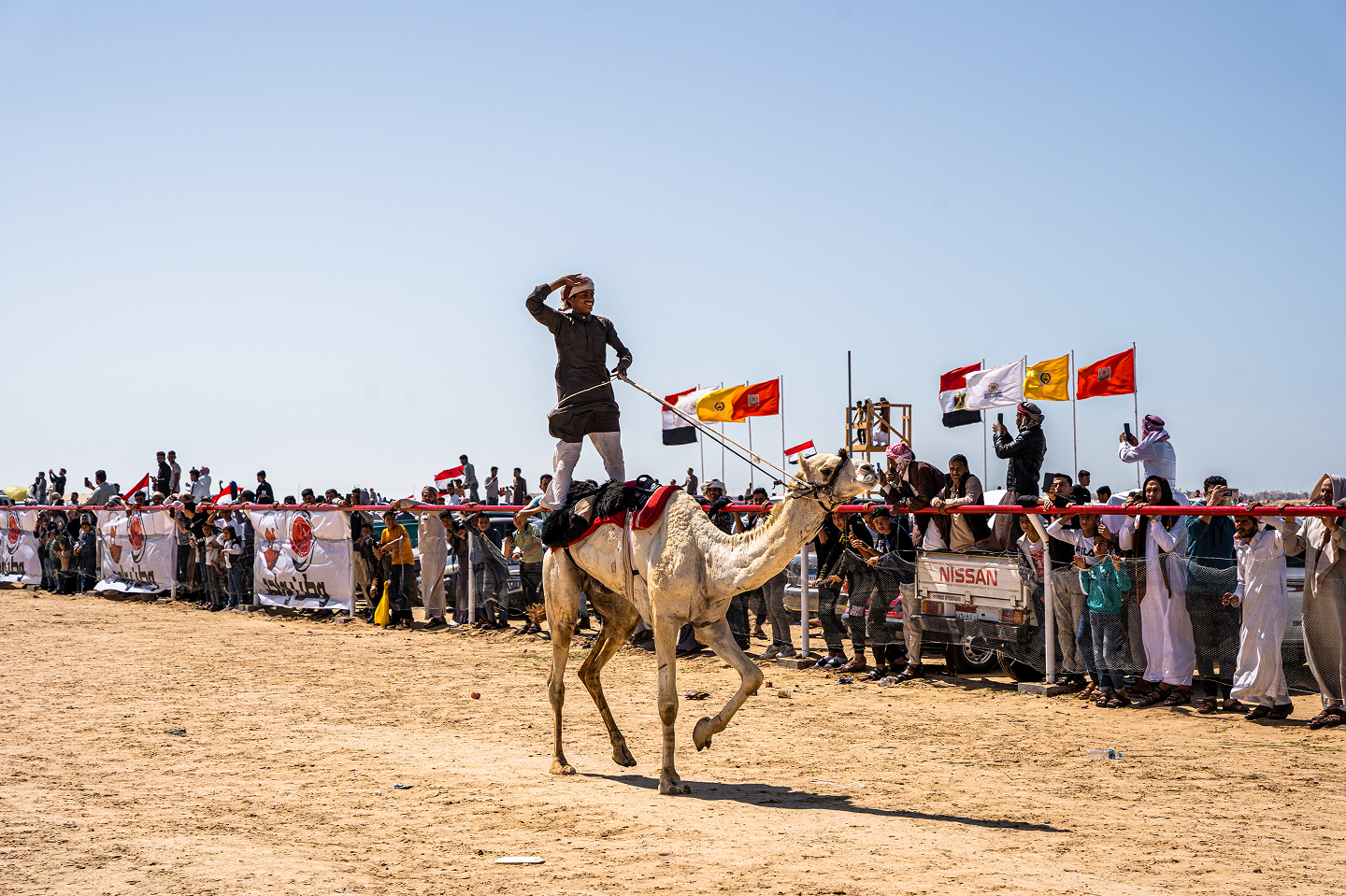
Ramadan Al-Balawi, 19 years old, has honed his camel training skills to the point of mastering acrobatic maneuvers, like jumping while riding, which he performs for show at the opening of the Al-Arish Camel Festival in 2023.
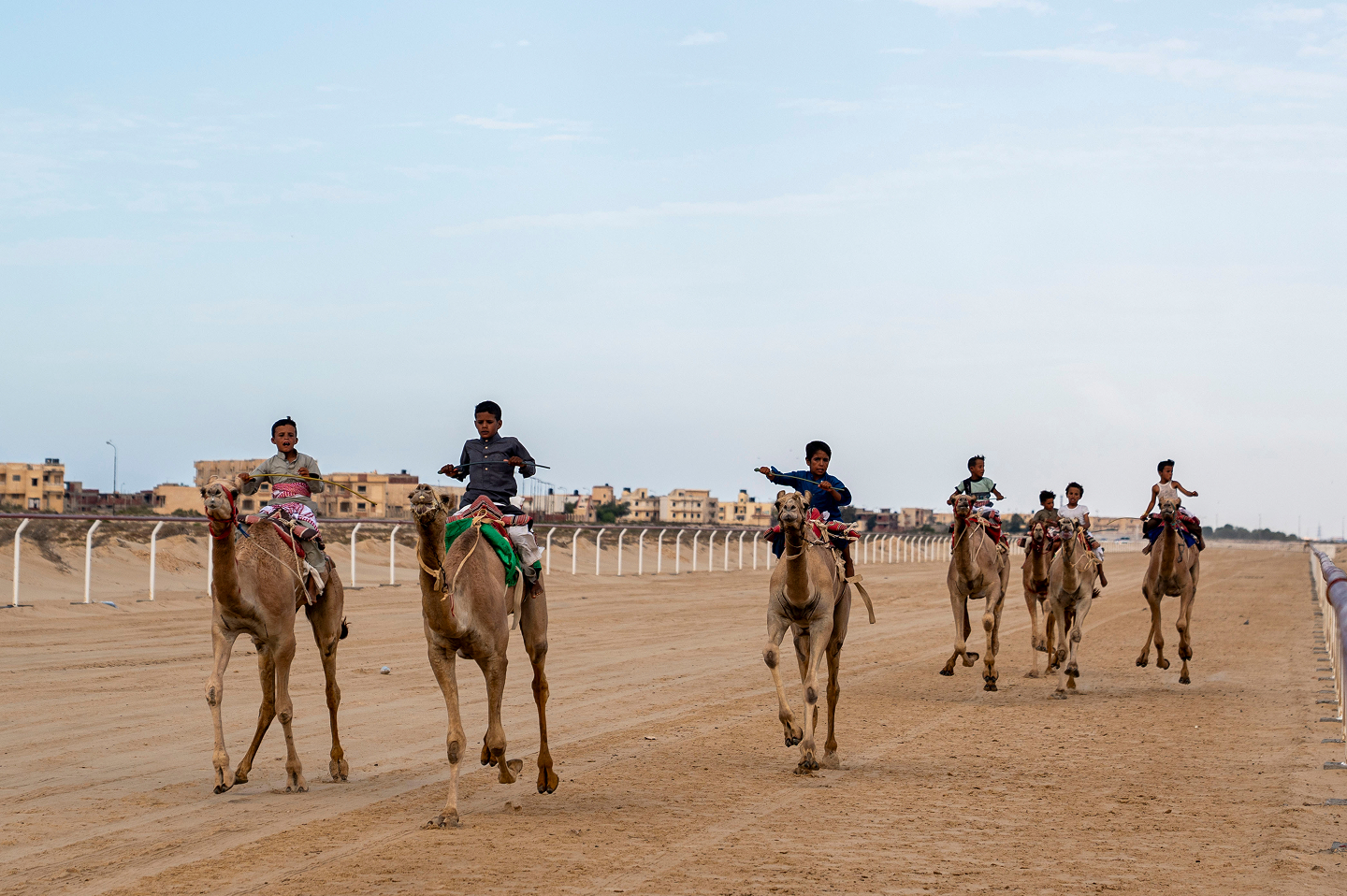
Six-year-old Abdulrahman, the younger brother of Ramadan Al-Balawi, races his peers to the finish line on the Al-Arish track. Abdulrahman’s entire life revolves around training camels and learning to ride them. "Brideehi"—"I love them," he answers in his dialect when asked about his deep connection to the camels at such a young age.
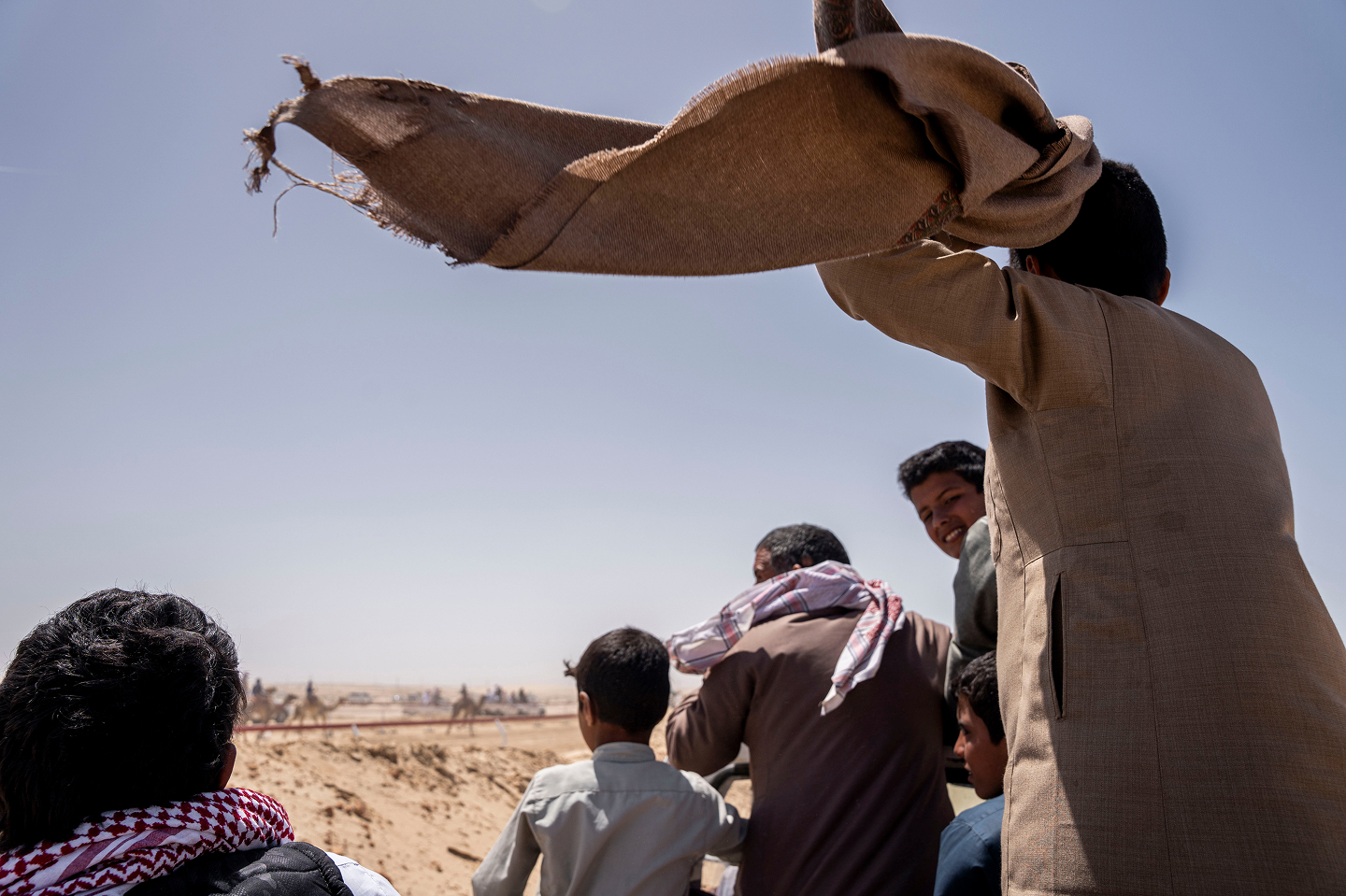
Handlers drive their cars at high speed alongside the track, both to ensure the safety of the jockeys in the human-rider heats and to operate the robotic jockeys in the automated ones. Here, seven-year-old Suleiman's family cheers him on from their car during the race.
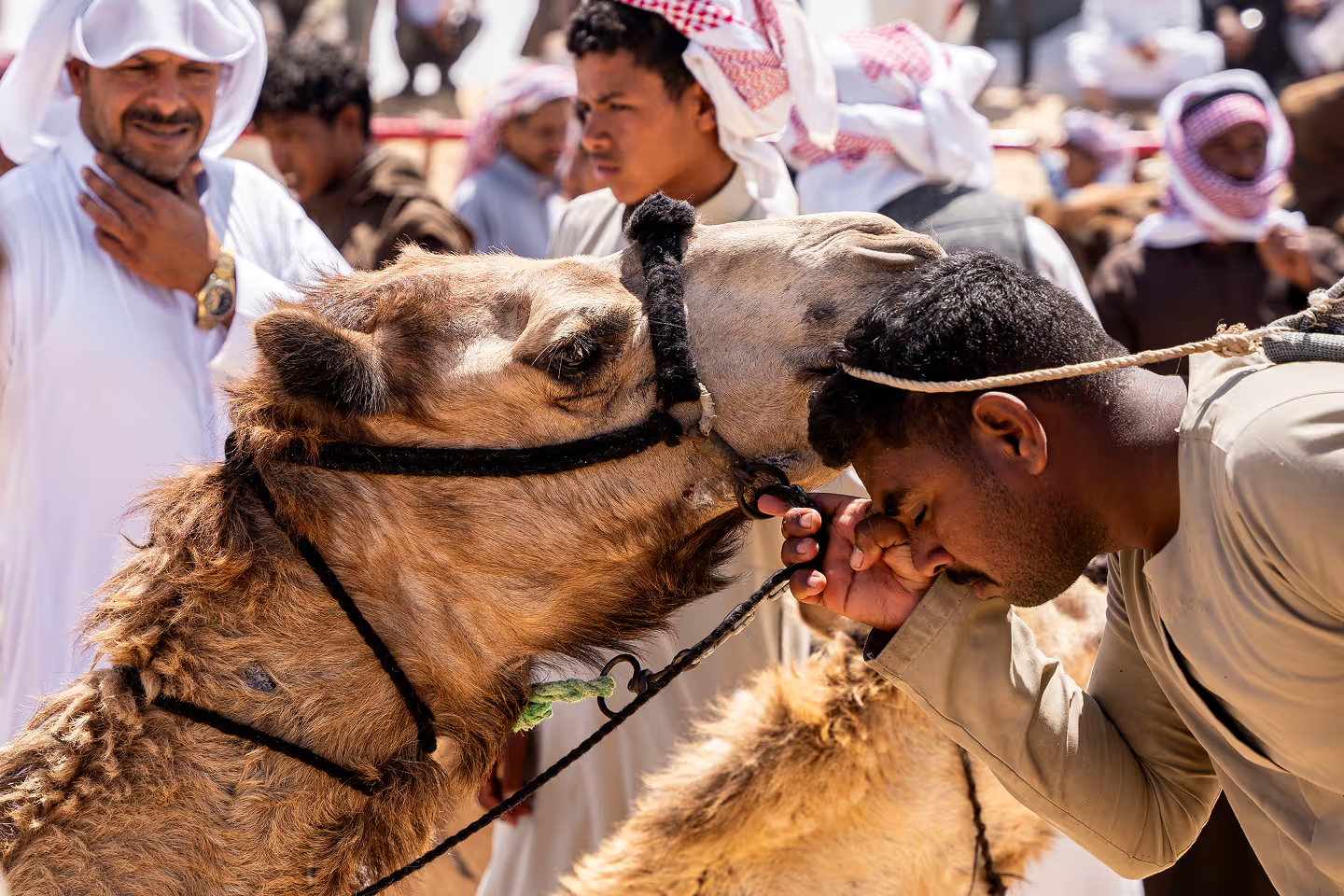
The race organizer awaits a signal from the finish line to give the starting command. The start is sudden and swift to ensure everyone begins at the same moment. After the abrupt start, a young boy, who was helping his jockey brother prepare, scrambles to get out from under the camels' feet.
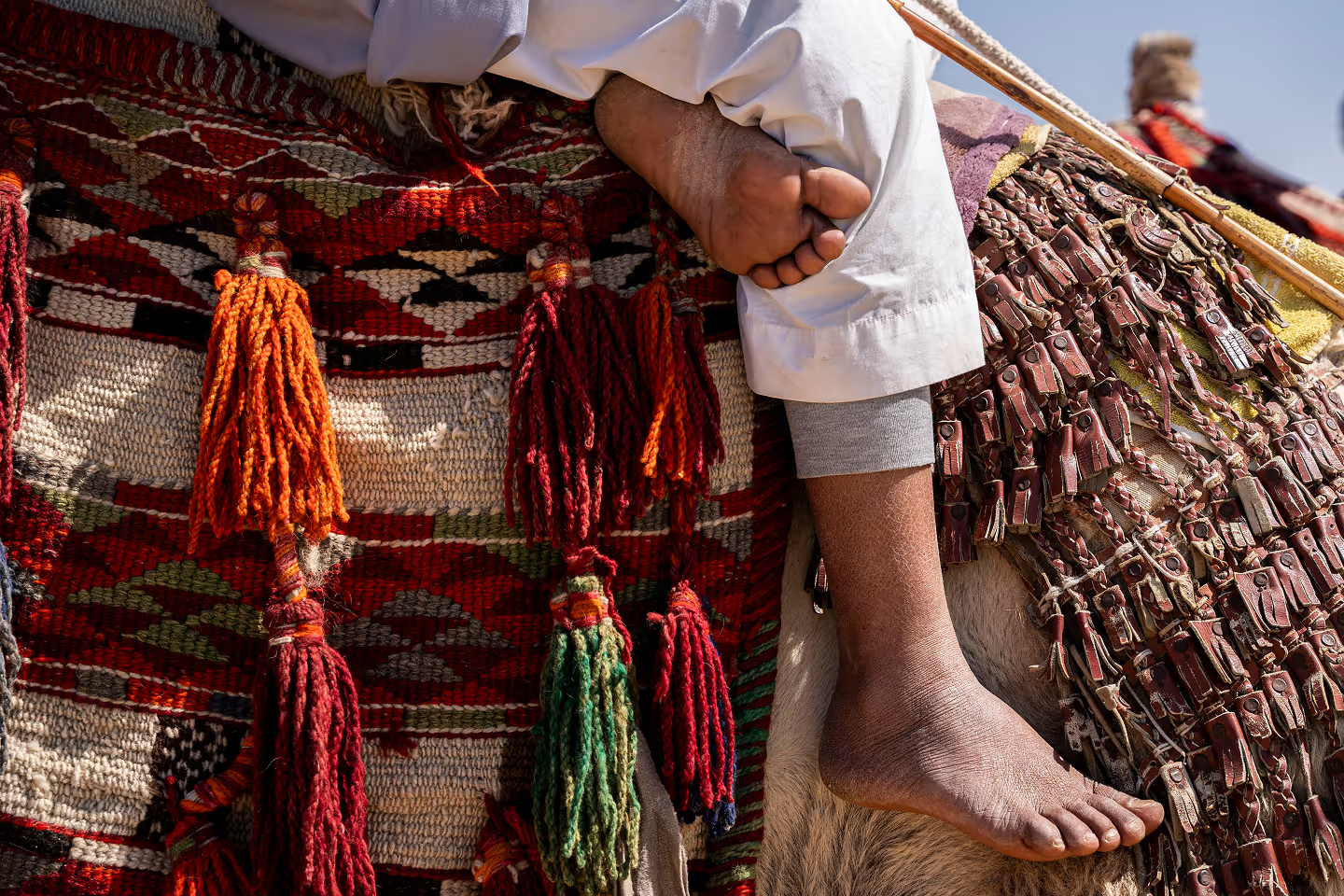
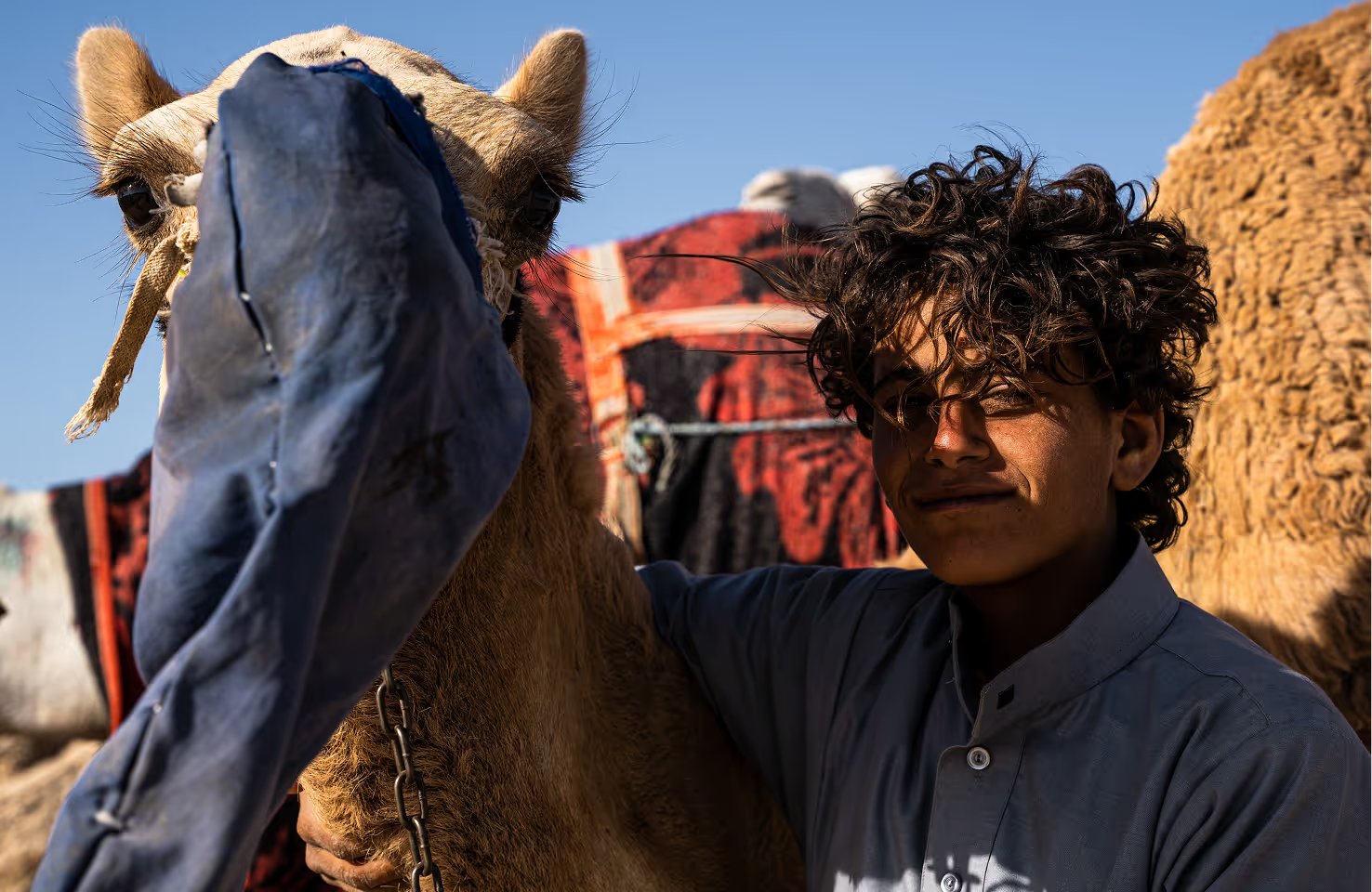
A jockey's life with camels sometimes begins at the age of three, following his older brother in training and feeding the family's camels. Ten-year-old Musaed, when I met him training camels in the Sinai desert, said that he won his first race as a professional jockey at the age of eight. Younger riders may win other races, but the only criterion for selecting a child to become a professional jockey is that he be a "birdihen," meaning he loves camels in the language of the Sinai Bedouins.
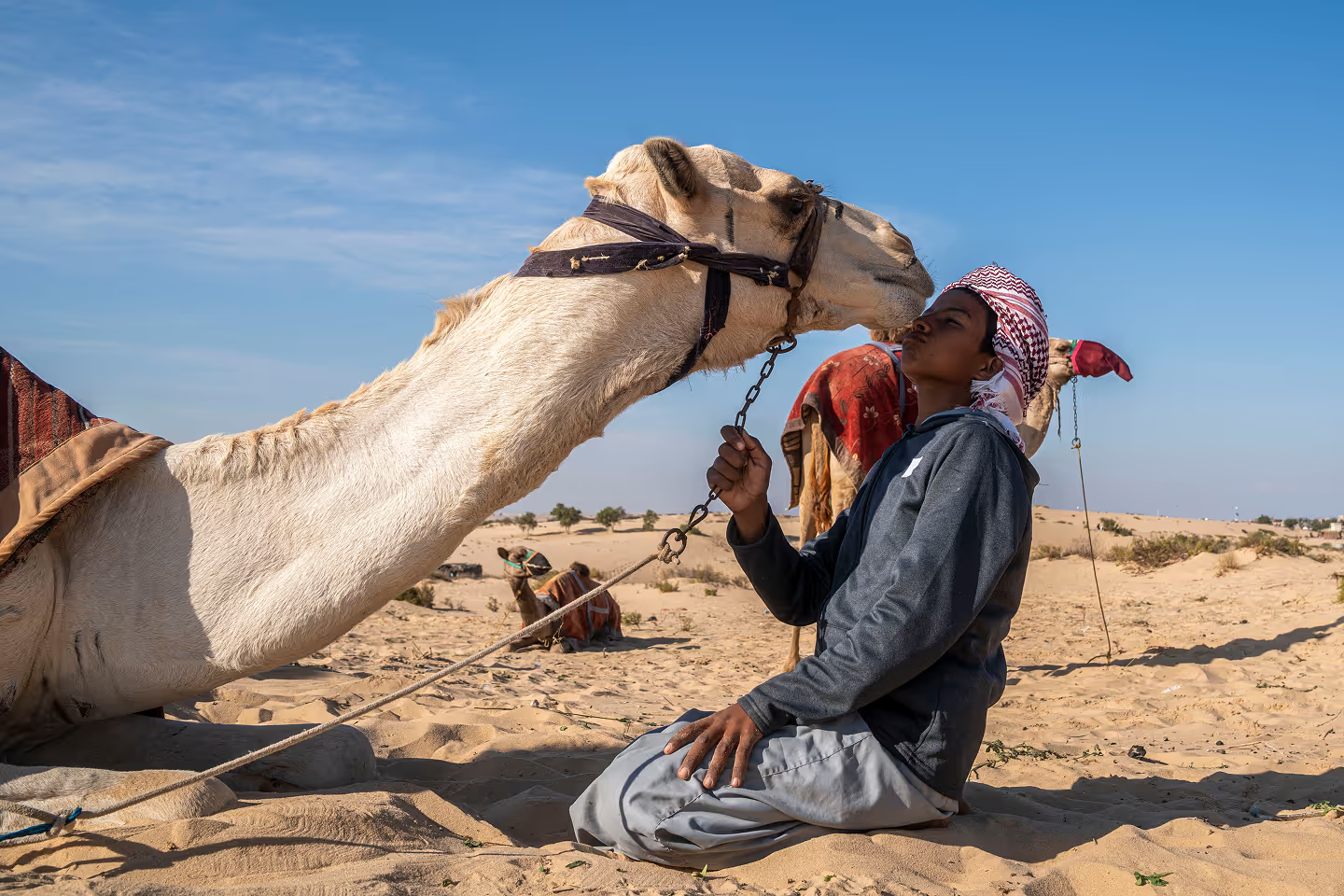
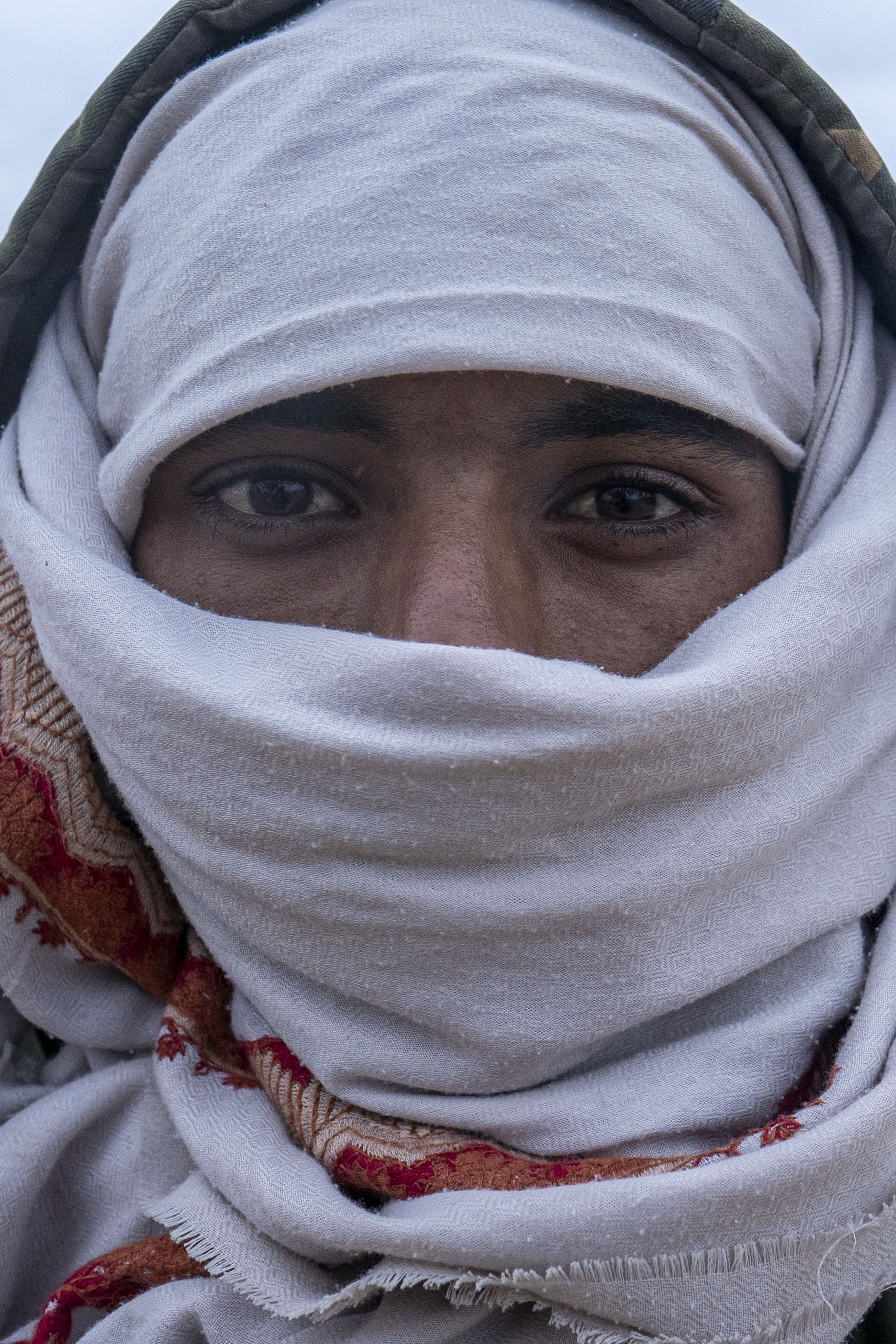
Mohammed Al-Sawarka, 20 years old, during a camel training session in the desert near Arish. Mohammed lives in the racetrack area due to its proximity to his village, but he often leaves to stay in the handlers' quarters at the Al-Arish Camel Club. He no longer competes much himself, but now focuses on training the younger members of his family to become professional jockeys.
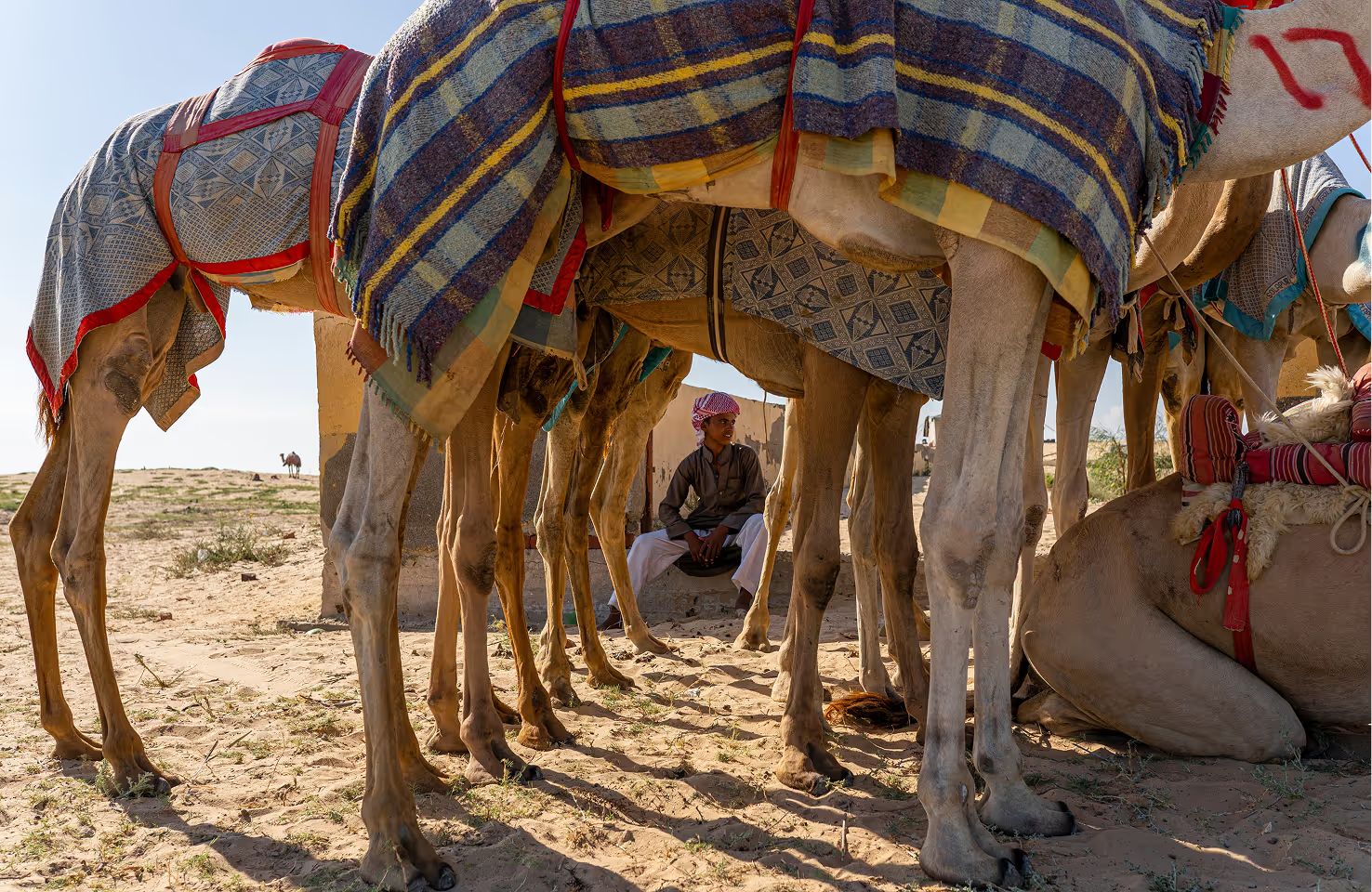
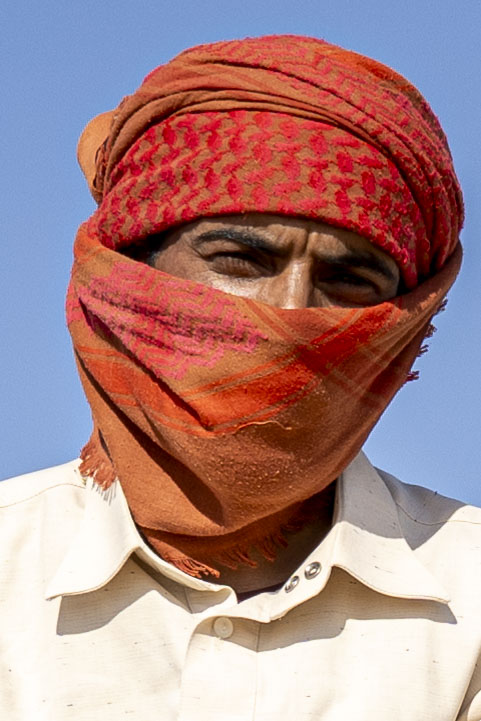
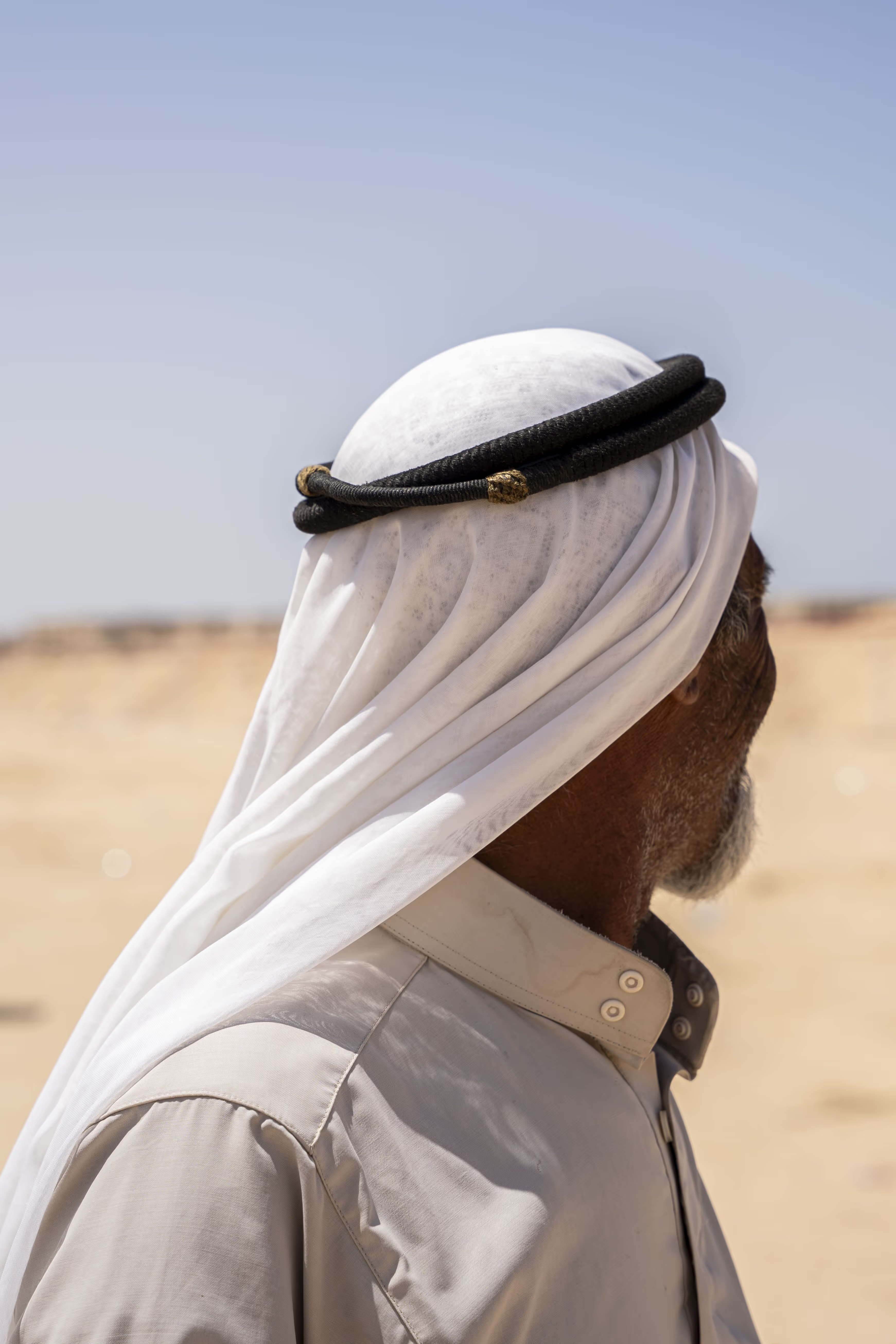
Portrait of a camel handler wearing the 'uqda' (a shawl in the language of the Sinai people) before the start of a race. The role of older handlers is often limited to training, as they cannot participate in the races due to the crucial need for the jockey to be lightweight.
The Bedouin homes in the Al-Midan area near Arish. These homes typically welcome local handlers as well as those from other regions, offering a place for rest and pasture for the camels.
During my journey documenting the life of the camel people in Sinai, I met Sheikh Atiya Al-Ahyawi by chance four times at the Al-Arish track. Sheikh Atiya calls me "the young man with the camera." Although he refuses to be photographed, he calls me over each time to talk about camels and the poetry of Oneiz Abu Salem Al-Tarabin. "Not all camels race well with the robot," Sheikh Atiya says. "Some camels, the purebreds, must have a human jockey."

In 2008, when the robot jockey appeared in Sinai, camel owners stopped racing camels, and all races were switched to robot jockeys. But people wanted human jockeys as Sheikh Attia explained, so the Bedouins brought jockeys back on camels.

Sheikh Atiya lives with his camels in the Jifjafa mountains of central Sinai, yet he makes sure to attend the races in Al-Arish, Sharm, and other tracks, despite the great distance from his home.The Bedouins in Sinai are trying to preserve their ancient heritage against the wave of modernity that has hit camel racing. This is the reality for all camel people in Sinai. They raise them, train them, and put their children on their backs in a constant effort not to let the robotic jockey replace the human rider – and preserve their culture.